
Which DPP requirements apply to which product groups?
Which DPP requirements apply to which product groups — and where are they set out today? This deep dive shows what has already been established for batteries, construction products, toys, detergents and cleaning products, as well as ESPR-prioritised product groups, and which requirements remain open.
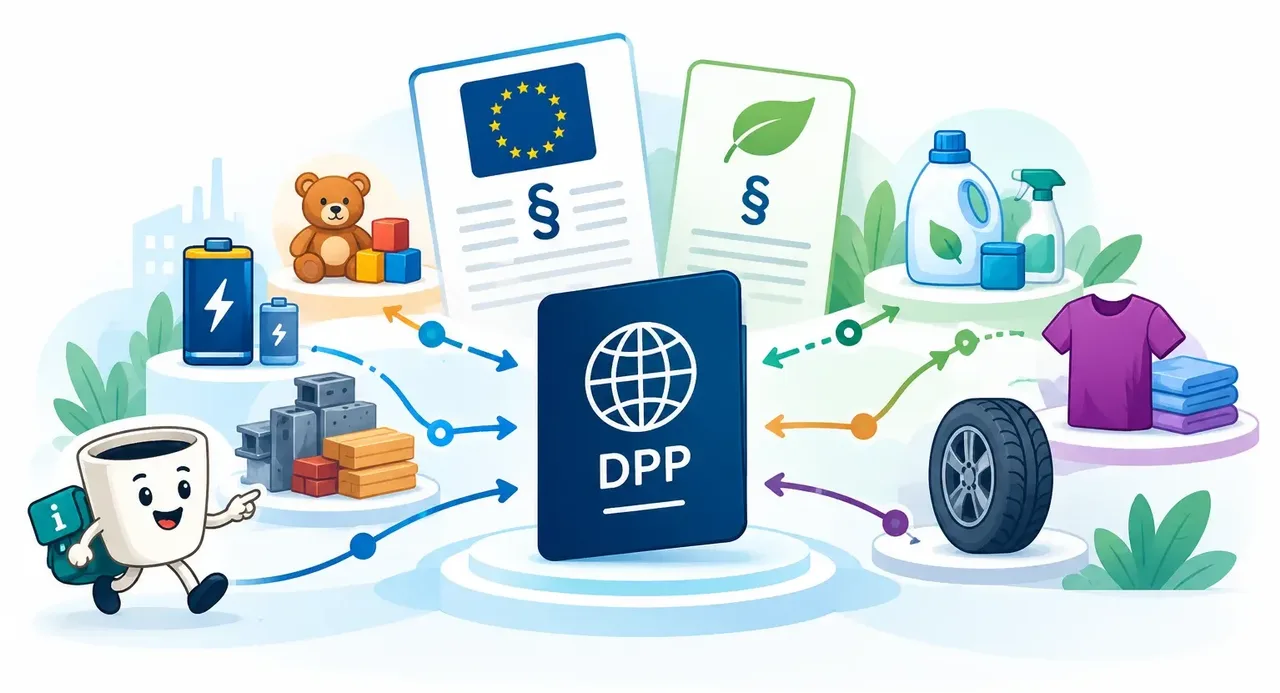
Why the product group is decisive
DPP requirements arise in different ways, but are always based on the respective product group:
- For product groups such as iron and steel, aluminium, textiles, tyres, furniture and mattresses, the ESPR (Ecodesign for Sustainable Products Regulation) provides the legal framework. Binding requirements are established only through product-specific delegated acts.
- For batteries, toys, construction products, and detergents and cleaning products, separate sectoral EU regulations already contain provisions on the Digital Product Passport. Whether additional delegated or implementing acts are required depends on the respective regulation.
- Several product-related EU laws may apply to a product at the same time. This applies, for example, to toys with batteries or energy-related construction products.
All DPPs should use the same basic technical system. An existing DPP can be supplemented with additional information if additional product-specific requirements apply to the product.
Where are the product groups defined?
Product group | Regulatory basis | Current milestone | Key focus |
|---|---|---|---|
Batteries | Batteries Regulation | DPP mandatory for certain batteries from 18 February 2027 | Raw materials, performance, service life, sustainability and recovery |
Iron and steel | ESPR | Product-specific delegated act in preparation | Environmental performance, CO₂ intensity and resource efficiency |
Construction products | Construction Products Regulation | Additional delegated act required on the basis of the sectoral regulation | Performance, conformity, sustainability and information for construction works |
Textiles | ESPR | Product-specific delegated act planned | Material transparency, durability and circularity |
Aluminium | ESPR | Product-specific delegated act planned | Environmental performance and resource efficiency |
Tyres | ESPR | Product-specific delegated act planned | Durability, performance and circularity |
Detergents and cleaning products | Detergents and Surfactants Regulation | DPP mandatory from 23 September 2029; additional implementing act supplements DPP requirements | Ingredients, conformity, labelling and market surveillance |
Toys | Toys Regulation | DPP mandatory from 1 August 2030; additional delegated act supplements DPP requirements | Product safety, conformity and traceability |
Furniture | ESPR | Prioritised in the 2025–2030 working plan | Durability, repairability and circularity |
Mattresses | ESPR | Prioritised in the 2025–2030 working plan | Material information and circularity |
Vehicles | Vehicles Regulation | DPP mandatory for certain vehicles from 1 September 2032 | Circularity, reuse and recycling |
Information and communication technology (ICT) products and other energy-related products | ESPR | Step-by-step assessment and regulation | Energy efficiency, repairability and product lifetime |
The dates of planned legal acts are initially regulatory roadmaps. The scope, information requirements and implementation deadlines become binding only through the applicable EU regulation and — where provided for — the associated delegated or implementing acts. The ESPR 2025–2030 working plan determines which product groups will be addressed as a priority.
You can find all current and planned regulatory milestones in the DPP timeline.
Product groups compared
Batteries: Transparency throughout the entire life cycle
Batteries are the first product group for which a comprehensive Digital Product Passport will become mandatory. From 18 February 2027, certain electric vehicle batteries, industrial batteries with a capacity of more than 2 kWh, and batteries for light means of transport will require a battery passport.
The Batteries Regulation distinguishes five main categories: portable batteries, starting batteries (SLI batteries), batteries for light means of transport (LMT batteries), industrial batteries and electric vehicle batteries. Not all battery categories will be subject to the battery passport requirement from February 2027. Portable batteries, such as batteries in smartphones or remote controls, and starting batteries will not require a battery passport at that time. Industrial batteries with a capacity of no more than 2 kWh are also not covered by this requirement.
The battery passport generally relates to the finished, functional battery, including the components necessary for its safe operation. Individual cells or modules do not automatically require their own battery passport.
The responsible economic operator is the one that places the finished battery on the EU market. For imported batteries, this is generally the importer. The battery passport must be created and registered in the EU DPP registry when the battery is placed on the market; for imports, generally no later than before release for free circulation under customs law.
In addition to largely static product information, the battery passport may also contain data that changes during use, for example:
- Charge and discharge cycles
- Performance and capacity development
- Operating conditions
- Condition and expected remaining service life
Changes during the further life cycle are also particularly relevant: In the event of a repair, the existing battery passport generally remains in place. If, on the other hand, a battery is repurposed or remanufactured, a new battery passport is created and a new economic operator assumes responsibility.
Information such as the carbon footprint, the share of recycled materials or due diligence obligations will not automatically be required in full from the first day of the battery passport requirement. What matters is when each individual requirement applies to the relevant battery category.
In focus:
The battery passport does not accompany the battery only when it is placed on the market. It will also document its condition, use and status changes throughout the rest of its life cycle, thereby supporting repair, further use, repurposing and recycling.
Toys: Safety and market surveillance at the centre
From 1 August 2030, toys covered by the new EU Toys Regulation must have a Digital Product Passport. In addition, a delegated act on technical specifications is planned and must be adopted at least 18 months before the DPP requirement takes effect.
For toys, the focus is not on environmental product performance. Here, the Digital Product Passport primarily serves to make compliance with applicable safety and conformity requirements verifiable and to support market surveillance. This product group therefore makes particularly clear that the DPP does not pursue sustainability objectives only, but is also used as an instrument for product safety and legal compliance.
The requirements also apply to new and used toys from third countries when they are placed on the market in the European Union.
The main focus areas are:
- Traceability of the toy
- Access to the declaration of conformity
- Control by market surveillance and customs authorities
- Identification of the manufacturer and other responsible economic operators
- Action against unsafe and non-compliant products
In focus:
Additional EU laws may apply to toys that are connected, radio-enabled or AI-based. If they contain a battery, it must also be assessed whether requirements under the Batteries Regulation apply.
Construction products: Long-term information for construction works and the circular economy
According to the current roadmap, the delegated act on the Digital Product Passport for construction products is planned for the second quarter of 2027. This timeline is indicative. The DPP for construction products is expected to become mandatory 18 months after this act enters into force. At that point, the final scope of the DPP requirement for the respective construction product families will have been established. In principle, however, the DPP requirement is already provided for in the Construction Products Regulation (EU) 2024/3110.
Construction products are often used for decades, permanently incorporated into construction works and potentially later removed, reused or remanufactured. The Digital Product Passport should therefore provide lasting, reliable access to information about their performance, conformity, intended use and environmental sustainability.
The main focus areas are:
- Performance and conformity information
- Intended uses
- Information on environmental sustainability
- Technical documentation
- Information on essential components
- Information supporting reuse and remanufacturing
In focus:
For construction products, the DPP provides an information basis for identifying, assessing and, wherever possible, reusing or remanufacturing construction products even after they have been removed. For certain energy-related construction products—such as heating appliances, heat pumps or ventilation systems—sustainability requirements may primarily be established under the ESPR rather than the Construction Products Regulation. The applicable rules must therefore be assessed on a product-by-product basis.
Detergents and cleaning products: Considering the DPP and digital labelling together
From 23 September 2029, detergents and cleaning products and surfactants supplied directly to consumers or other end users must have a Digital Product Passport. Transitional provisions apply to products placed on the market under the previous regulation before this date. In addition, an implementing act on the technical specifications of the DPP is planned. It must enter into force at least 18 months before its application begins. Further adjustments to the DPP information requirements may be made through delegated acts.
For this product group, the Digital Product Passport and digital labelling are closely linked. The data carrier for the DPP may also provide access to additional labelling information. It must be affixed to the label, the packaging, the accompanying documents for unpackaged products, or the refill station for refill systems, and must be visible before purchase.
The main focus areas are:
- Product and manufacturer identification
- EU Declaration of Conformity
- Ingredient information
- Information on biodegradability
- Labelling and use information
- Information for consumers, market surveillance authorities and customs authorities
- Information for refill systems and online sales
In focus:
For detergents and cleaning products, a common data carrier provides access to the Digital Product Passport and digital labelling information. This is particularly relevant for products sold online and for refill systems, where information must also be reliably accessible without conventional individual packaging.
Vehicles: A circularity passport covering the entire life cycle
As of 1 September 2032, certain vehicles must have a digital circularity passport. The vehicle regulation applicable for this purpose does not refer to the passport for vehicles as a “DPP,” because it places a particular focus on circularity: repair, reuse, remanufacturing and recycling are at the centre. The technical requirements for the digital circularity passport will be specified by implementing acts by 14 August 2030; individual requirements may also be amended by delegated acts.
The digital circularity passport applies to vehicles in classes M1 (passenger cars) and N1 (light commercial vehicles). Vehicles in classes L, M2, M3, N2, N3 and O are excluded; vehicles with special purpose are also excluded. The information to be included in the circularity passport includes:
- Information on removing and replacing parts, components and materials
- Information on certain substances contained
- The declaration of recycled content (the proportion of recycled material incorporated into the new product)
- The official spare parts catalogue for the vehicle type
It should be interoperable with and, where possible, integrated into other vehicle-related passports required under EU law, in particular the battery passport. If required information is already accessible through another interoperable passport, it does not need to be provided additionally in the circularity passport.
In focus:
The digital circularity passport for vehicles is primarily focused on the vehicle’s circularity and the use of its parts and materials throughout its life cycle. The interaction with other digital passports, such as the battery passport, is particularly relevant.
What applies to imported products?
Whether a product was manufactured inside or outside the European Union is generally irrelevant to the DPP requirement. What matters is whether it falls under the rules applicable to its product group and is placed on the EU market.
Imported products are therefore not exempt from the DPP requirements. In principle, the same product-specific requirements apply to them as to comparable products manufactured within the European Union. These may include, in particular, requirements concerning the Digital Product Passport, the product information required in it, the unambiguous linking of the DPP to the product, and data availability.
Components or intermediate products from third countries may also be relevant to the DPP of a finished product manufactured in the European Union.
This is illustrated by batteries: If a finished battery subject to the DPP requirement is imported from a third country, its battery passport must already be available when it is placed on the market and must be registered in the EU DPP Registry. Upon import, this is generally required no later than before the goods are released for free circulation under customs law. If, on the other hand, only battery cells or modules are imported and then assembled into a finished battery in the European Union, these parts do not automatically require their own battery passport. In principle, the decisive factor is the finished, functional battery.
For companies, this means that even if only components or intermediate products are sourced from third countries, it must be clarified at an early stage which information is required for the DPP of the subsequent finished product and whether it is available in full, reliably and in the required form.
In focus:
For the DPP requirement, the country of manufacture is not decisive; what matters is whether the product is placed on the EU market and falls under the applicable product-specific rules.
ESPR-prioritised product groups for which the specific requirements are still open
It has already been established that the product groups iron and steel, aluminium, textiles, tyres, furniture and mattresses will be included in the ESPR Working Plan 2025–2030. However, the exact products that will be affected and the information that the DPP must contain will only be specified in the respective delegated acts.
The next regulatory milestones fall between the end of 2026 and 2029: The delegated act for iron and steel is scheduled for the fourth quarter of 2026; for textiles, aluminium and tyres, the acts are expected to follow in the third or fourth quarter of 2027; for furniture in 2028; and for mattresses in 2029.
For iron and steel, the focus is currently on environmental performance, CO₂ intensity and the use of secondary raw materials. Iron and steel are also the first intermediate product group for which specific requirements are being prepared under the ESPR.
Although the mandatory information has not yet been finalised, companies can already take the following steps:
- Identify relevant data sources and supplier information
- Clarify responsibilities
- Structure and assess existing product information
The respective delegated act will subsequently make this preparation more specific on the basis of the binding requirements.
In focus:
Unlike batteries, toys, or detergents and cleaning products, for which sectoral regulations already contain binding DPP requirements, no binding DPP requirements can yet be derived for ESPR-prioritised product groups from prioritisation alone.
What companies should take away from these differences
Companies should not assume that there is a universally applicable DPP data set. Each relevant product portfolio must be assessed separately:
- Which legal provisions apply
- Which products are subject to a DPP requirement
- Whether different DPP requirements apply to different product variants
- When the obligations take effect
- Which information and evidence are required
- Whether other EU legislation must be taken into account in addition to the regulation primarily applicable to the product
- Whether the required information for imported products, components or intermediate products from the supply chain is available
Remember
The product group determines which Digital Product Passport is required. Only the relevant EU legislation establishes which products are subject to a DPP requirement, which information and evidence will be required, and when the obligations take effect. Several pieces of EU legislation may be relevant to a product — for example, a heat pump may be subject both to the Construction Products Regulation and to requirements based on the ESPR.
Sources
- Regulation (EU) 2024/1781 of the European Parliament and of the Council of 13 June 2024 establishing a framework for the setting of ecodesign requirements for sustainable products (ESPR)
- European Commission: Ecodesign for Sustainable Products and Energy Labelling Working Plan 2025–2030, 16 April 2025
- European Commission: Construction Products Regulation Working Plan 2026–2029, 16 December 2025
- European Commission: Digital Product Passport – Frequently Asked Questions (FAQ), Version 1.0, February 2026
- Regulation (EU) 2026/1738 of the European Parliament and of the Council of 8 July 2026 on requirements for the circular design of vehicles and on the management of end-of-life vehicles
- Regulation (EU) 2023/1542 of the European Parliament and of the Council of 12 July 2023 concerning batteries and waste batteries
- European Commission (DG GROW): The EU Digital Product Passport for Batteries – Webinar 2: Latest Updates, Key Requirements and Industry Perspectives, 7 July 2026
- Regulation (EU) 2025/2509 of the European Parliament and of the Council of 26 November 2025 on the safety of toys
- Regulation (EU) 2024/3110 of the European Parliament and of the Council of 27 November 2024 laying down harmonised rules for the marketing of construction products
- Regulation (EU) 2026/405 of the European Parliament and of the Council of 11 February 2026 on detergents and surfactants
- Joint Research Centre: Methodology for defining data requirements for the Digital Product Passport under the ESPR framework, 19 March 2026
- Joint Research Centre: Study on DPP content for iron and steel products under the ESPR, 23 March 2026